A Guitarist's Christmas: Christmas Carols for Classical Guitar
- spotlight
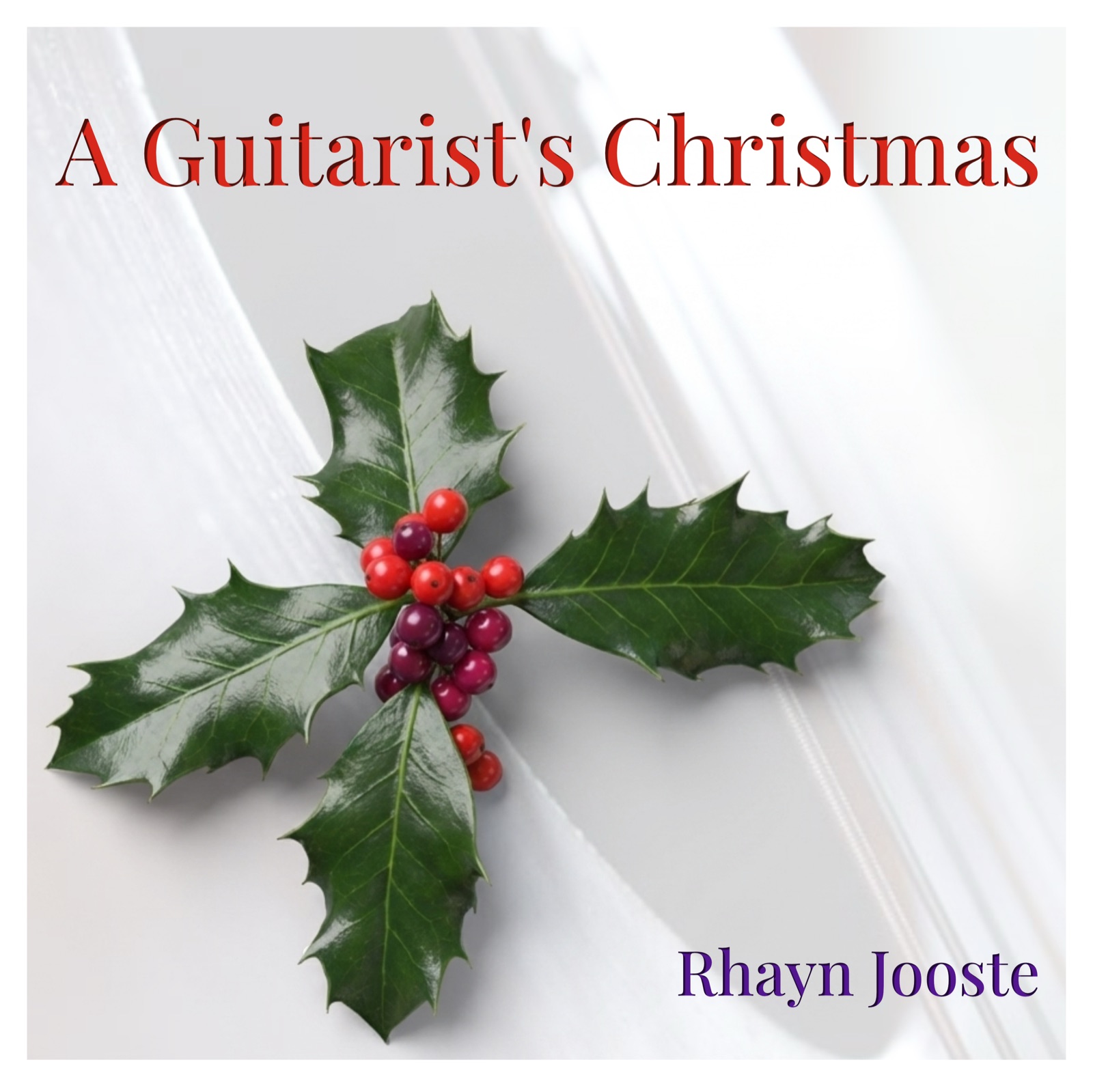
A Guitarist’s Christmas is my first musical release in a long time. My last EP, Paris, came out in 2016, so this one has been a while coming. I have tried my best to create something different here: traditional Christmas carols for classical guitar, every one of them arranged by me, and all on a nylon set of strings. Some are solos, one is a duo, and two are for a full guitar quartet.
You can listen to the four main tracks on Spotify. The live bonus track is only on the Patreon release.
The tracks: guitar solo, duo and quartet
- Coventry Carol (guitar duo)
- Silent Night (guitar solo)
- Shchedryk ‘Carol of the Bells’ (guitar quartet)
- Chorale 46 & Fugue (guitar quartet)
- Bonus track: Shchedryk ‘Carol of the Bells’, live 2024 (guitar solo)
Written to be heard as a suite
Here is the blurb from my liner notes to explain further:
Welcome to A Guitarist’s Christmas. This EP is my homage to traditional Christmas carols, my love of arranging; and all on a nylon set of strings. This EP has been structured in a specific manner. In my mind, it works as a suite of music, each track slotted in to complement the mood, tempo, and feel of the tracks before, and after it. Ending on the most beautiful warm chord in the ‘Frankensteined’ Chorale 46.
So it is worth hearing in order, at least the first time through.
If you want to see how I think about putting harmony under a carol melody, Christmas Carol Harmony Part 1 works through the Coventry Carol step by step.
Chorale 46 & Fugue: Bach’s Christmas melody for guitar quartet
This is my favourite piece on the EP, and the one I want to tell you about. Here it is:
As a classical guitarist, one of the most beautiful, and seriously challenging, pieces to learn is the Prelude, Fugue and Allegro, BWV 998, by J.S. Bach. Whilst I was learning it, years ago, I noticed that the Fugue melody was taken from a Bach chorale, which he stole from a melody by Martin Luther. That melody started life as a traditional folk tune, which Luther set to words (Vom Himmel hoch, da komm’ ich her) in 1539, in a Christmas setting, supposedly for his children.
I have stolen, reset and arranged Bach’s original chorale setting for four guitars, then added the first fugue entries from BWV 998 to make a new work. Still with me? Bach steals from Luther, Luther steals from folk musicians, I steal from Bach.
If you want to learn the original, my Bach Fugue BWV 998 lesson takes it section by section.
So why is it a Christmas carol?
The melody is Chorale No. 46 in the Bach chorales edited by Albert Riemenschneider, and it is one Bach reuses again and again. His most famous setting is in the Christmas Oratorio, BWV 248, but it turns up in plenty of other places. If you want another instance, listen to BWV 700, or his canonic variations, BWV 769. He obviously loved the tune. Mostly, though, it is tied to the Christmas Oratorio. That, and the Luther Christmas connection, is why I included it.
A Frankenstein built for teaching
This Frankenstein of a piece came out of trying to help my students learn and understand the Fugue: its structure, its entries, and the exposition Bach built in BWV 998. First I pulled out all four voices of the chorale. Then I did the same for the Fugue and placed each entry in the matching voice. That gave me an arrangement for four guitars, which I then sat on for a number of years.
In the end I took the risk, recorded it, and put it on the EP. I am so glad I did. The sound is wonderful (I mean, it’s Bach) and the setting works. You can clearly hear the original melody, and then how Bach adjusted it to make a “correct” fugal subject. (The original needed tweaking to make sure it would flow across each entry.)
How I mixed it
I did not take the traditional classical route when mixing this. I used what I have learnt from mixing and mastering popular music instead. Guitars 1 and 4 sit dead centre, as their ranges allow it, and guitars 2 and 3 are panned left and right. That gives a fairly big, tight soundscape.
I love how it ends. I would have let it linger longer, but there is a string swipe near the end in guitar 1, so I had to fade it a little earlier.
Get A Guitarist’s Christmas
I wish everyone a fantastic festive Christmas, and a great holiday if you don’t celebrate it.
Rhayn