Learn Estudio No. 16 by Aguado
- Fast Scales / Speed Bursts
- LH Chord Shapes
- Legato — Hammer-ons
- Legato — Pull-offs
- Scale Coordination
- String Crossing
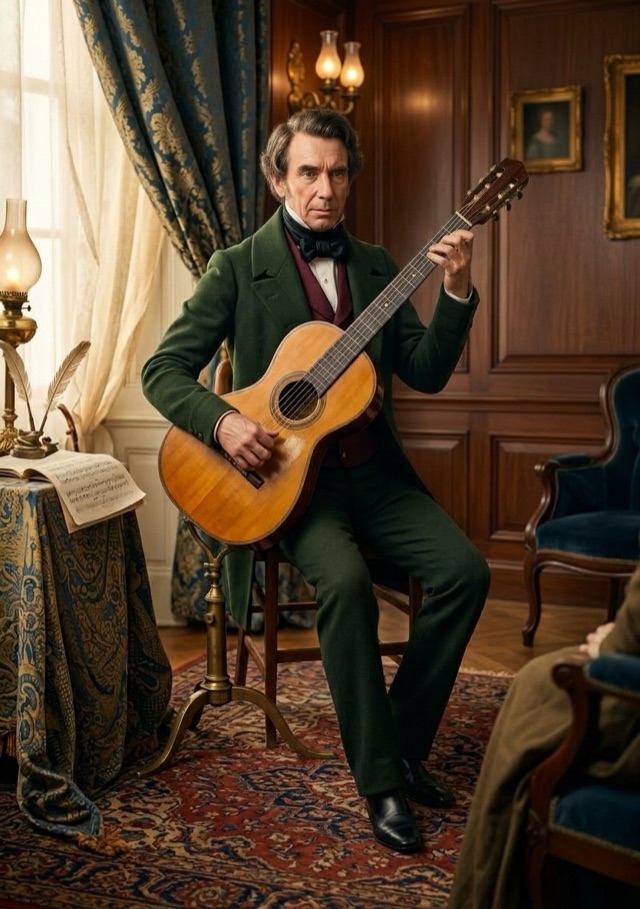
Struggling to get your scales fast and clean across the strings? Aguado’s Estudio No. 16 works on exactly that. It is tiny, it sits near the back of his monumental Nuevo Método para Guitarra of 1843, and most guitarists skip straight past it. Don’t. In a handful of bars Aguado sets both hands to work on synchronisation, in a truly Spanish fashion. He was 59 when he wrote the method, retired to Madrid and at the height of his powers, and he poured everything he knew about the guitar into it. There is very little in technique or sound production he did not consider. In this lesson I use No. 16 to work on alternating fingering, coordination, speed, string-crossing, left-hand slurs and chord changes, one micro study at a time.
There are two videos for this lesson. The first plays through the micro studies:
The second is a lesson discussion, with extra exercises and insights into the study:
Aguado and Sor
Aguado spent 11 years in Paris, the city that sheltered Chopin, Paganini and Liszt through revolutionary times. There he played, taught and even lived with Fernando Sor. As composers, the two could not have been more different. Sor was right in the thick of the musical life of his day, and his writing has a depth Aguado’s lacks. Aguado makes up for it with a real eye for detail and plenty of flair, in music written for the guitar and nothing else. He wrote for no other instrument, which was unusual at the time. And here is the detail that matters most to you as a modern player: Aguado used nails. Sor did not.
Picado or apoyando?
Aguado was a thoroughly Spanish guitarist, so he was probably using picado for his scale runs. That is speculation, so in this lesson I treat picado, tirando and apoyando as one action: alternating. Picado is to flamenco what apoyando is to classical guitar. Picado is an alternated i m rest stroke, with straighter, more energetic fingers and the thumb anchored on string 6. Apoyando is also an alternated rest stroke (and not only i m), with more curl from the middle joint, less accent, and the thumb tracking the fingers across the strings.
Playing fluidly and fast comes down to the return. Get the finger back to its start position as early and as relaxed as you can, and the next stroke arrives sooner. Below are two of Aguado’s own exercises from the 1843 method. I have put Ex. 25 first for a reason: look at the repeated i finger. Ex. 24 No. 2 builds that fast return further, and No. 1 adds coordination and slurs. Use more than Aguado’s i m to get the full benefit from them.
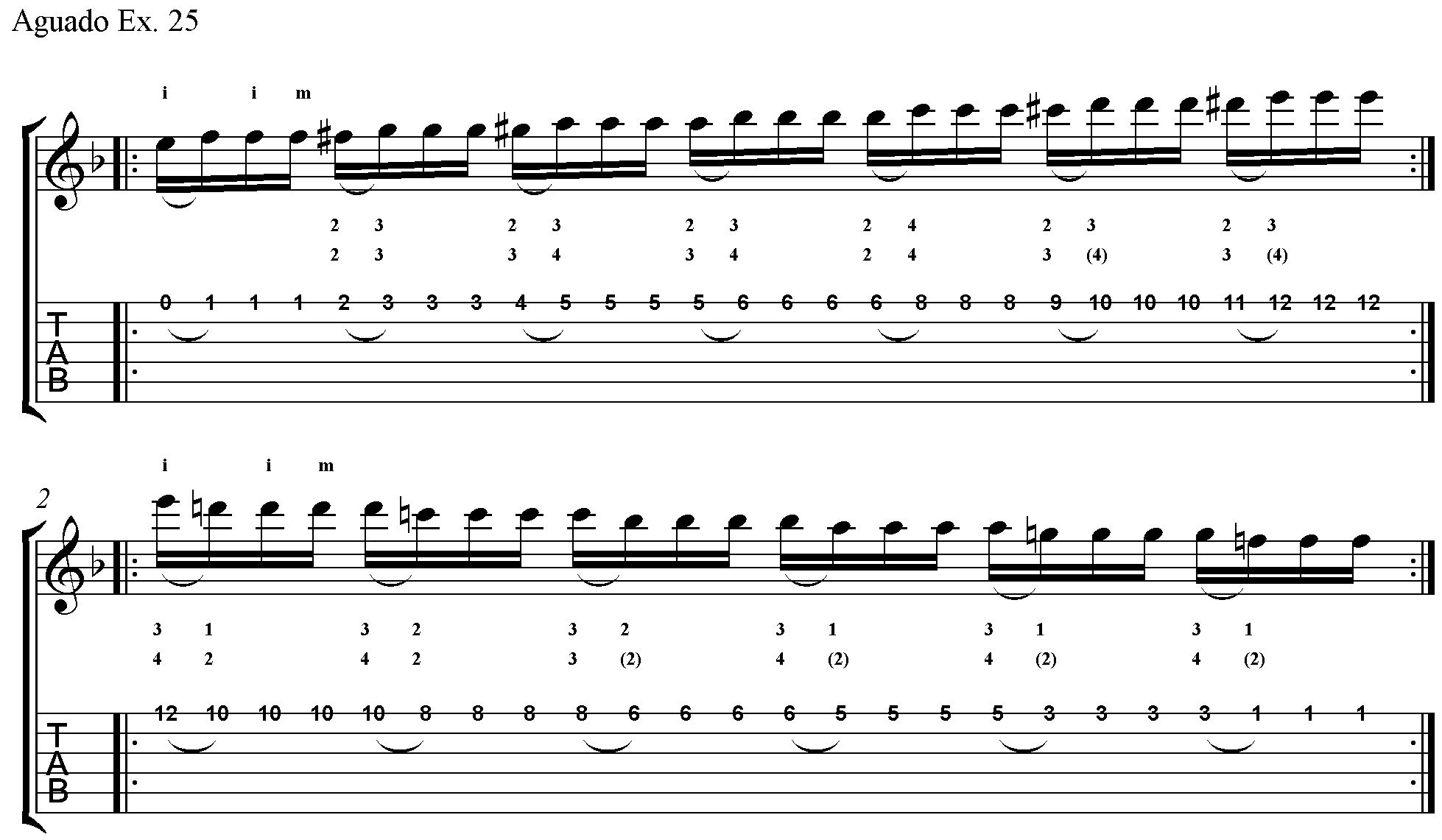
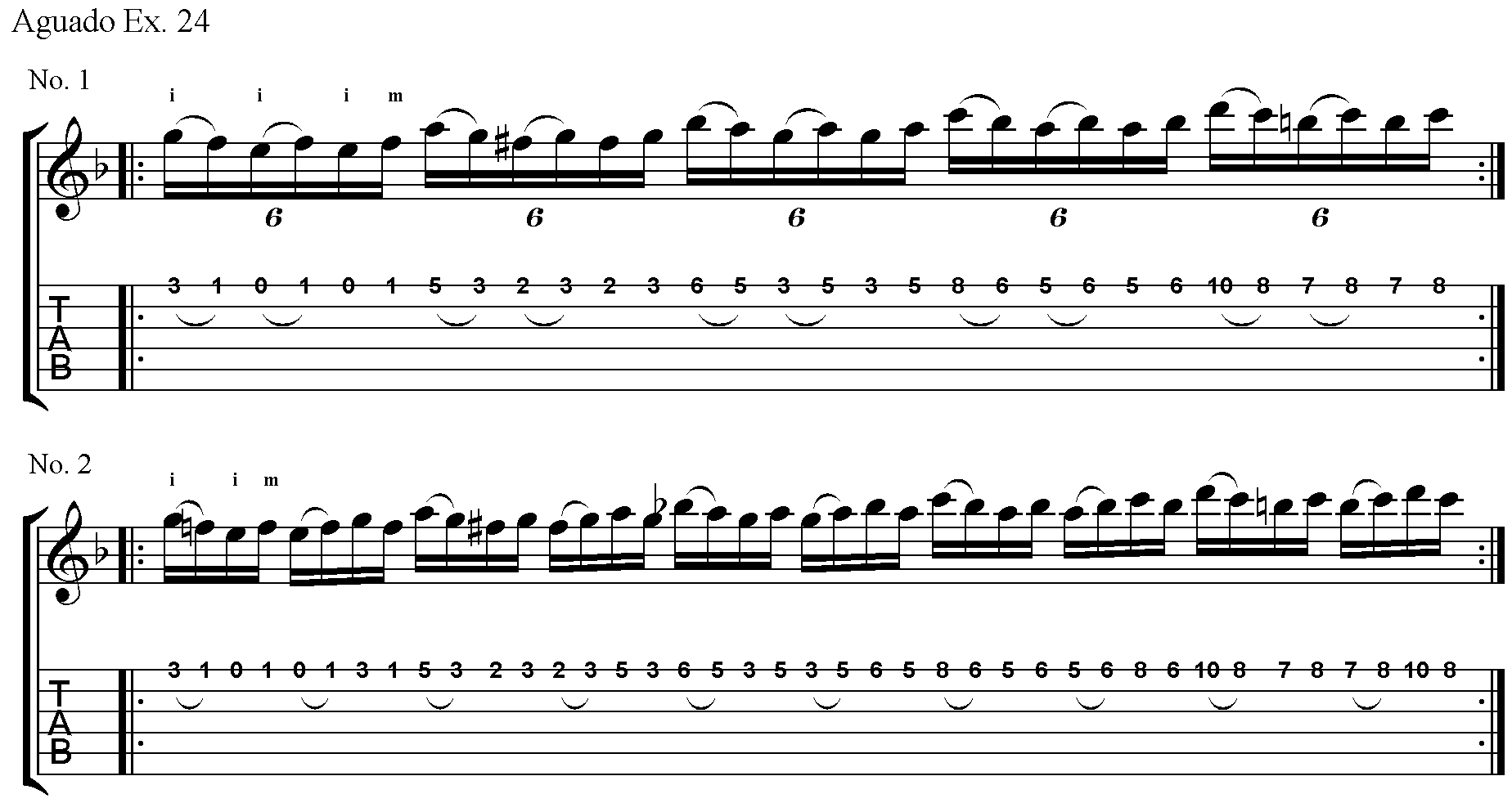
If these strokes are new to you, Rubén Díaz’s YouTube channel is full of great picado videos. Scott Tennant’s Pumping Nylon and Martha Masters’ The Total Classical Guitarist both cover right-hand positioning thoroughly, and Matt Palmer’s The Virtuoso Guitarist teaches the three-finger approach to scales.
Right hand
No. 16 opens by alternating sextuplet scale fragments with chord shapes, and the challenge grows as the ideas climb the fretboard: two bursts across two strings, then three across three. Most guitarists can play fast on one string. Crossing strings at speed is where it falls apart.
Micro Study 1 isolates exactly that, on open strings: alternating fingering, thumb tracking, then speed bursts. Paco de Lucía practised his right hand on open strings, and if it works for him it will work for you. Keep the arm relaxed and move the hand across the strings from the back and shoulder blade, never by lifting the collarbone.
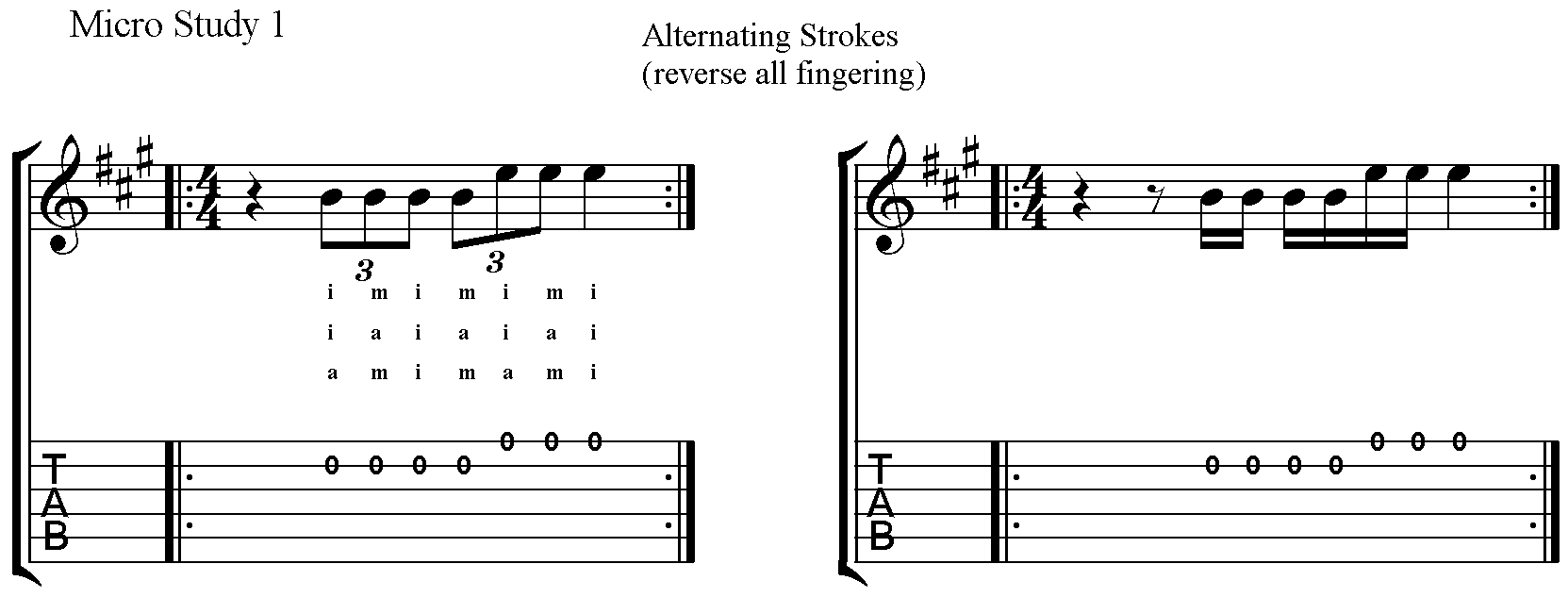
At slower tempos it gives you six fingerings: two common ones, a three-finger one, then all three reversed. As the BPM climbs you have to choose. Is it i a, like Leo Brouwer and John Mills? The Aguado-approved i m? Or the modern three-finger method of the Assad Brothers and Matt Palmer? Pick one, stick with it and nurture it. Any grouping will take you to 120bpm and beyond. Past 130bpm, use your favourite.
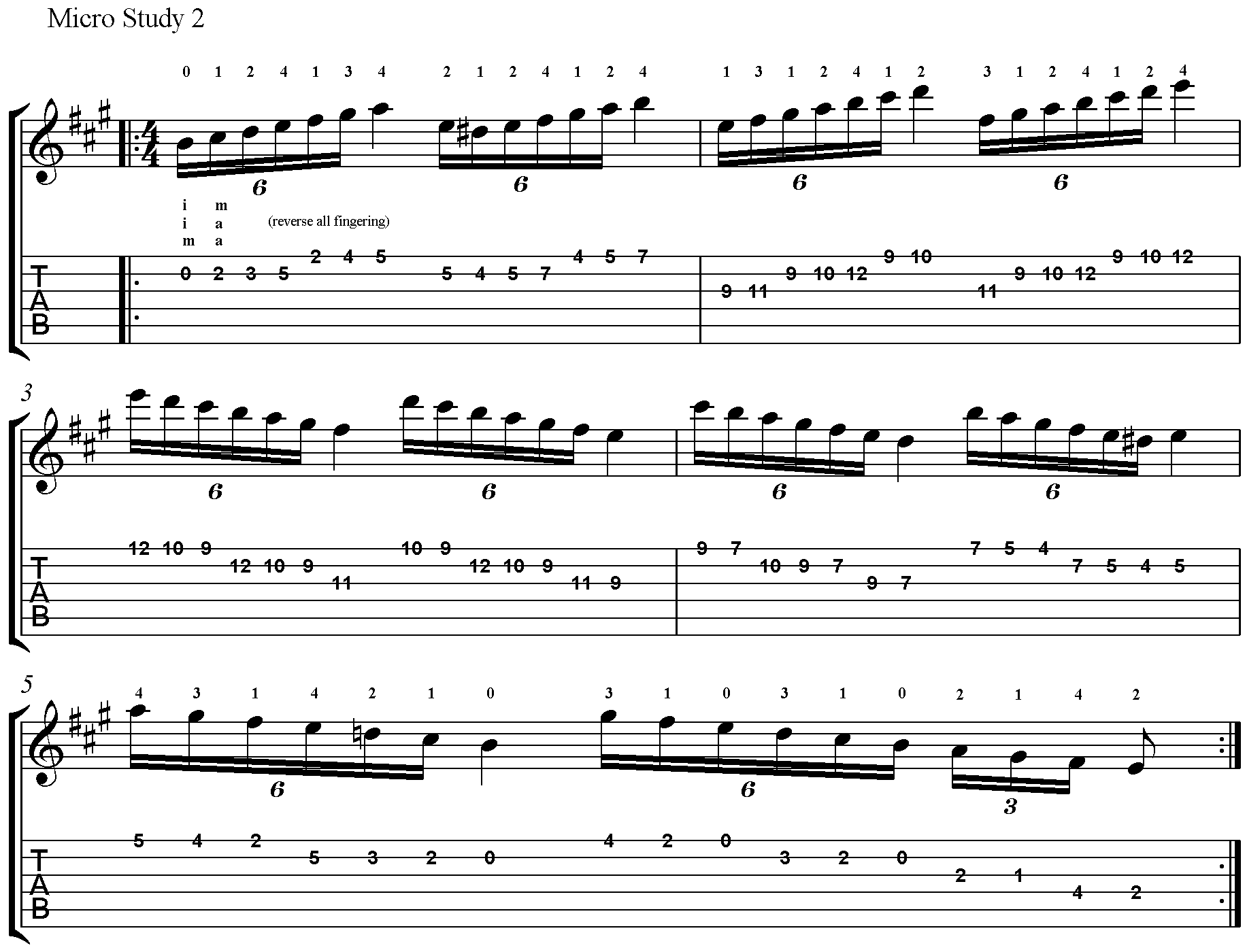
Micro Study 2 brings the left hand back in and stretches Aguado’s idea across 12 frets, then reverses it so you build fluency up and down the scale. The triplets give you irregular string-crossing combinations, which is what builds stamina. If it feels like a leap from No. 1, put Aguado’s original left-hand notes into No. 1 first. Short bursts of speed are how you get faster overall.
Micro Study 3 extends Aguado’s own one-bar suggestion at the bottom of the original page: 32nd-note practice. Same fragments, same fingerings, faster rhythm. Play it after section A and Micro Study 2. Use the rests to relax the fingers completely before the next burst, and break it into quarter-note chunks if you need to. Aguado’s note under the study, in his own words, also asks for something you might not expect in 1843: planting.
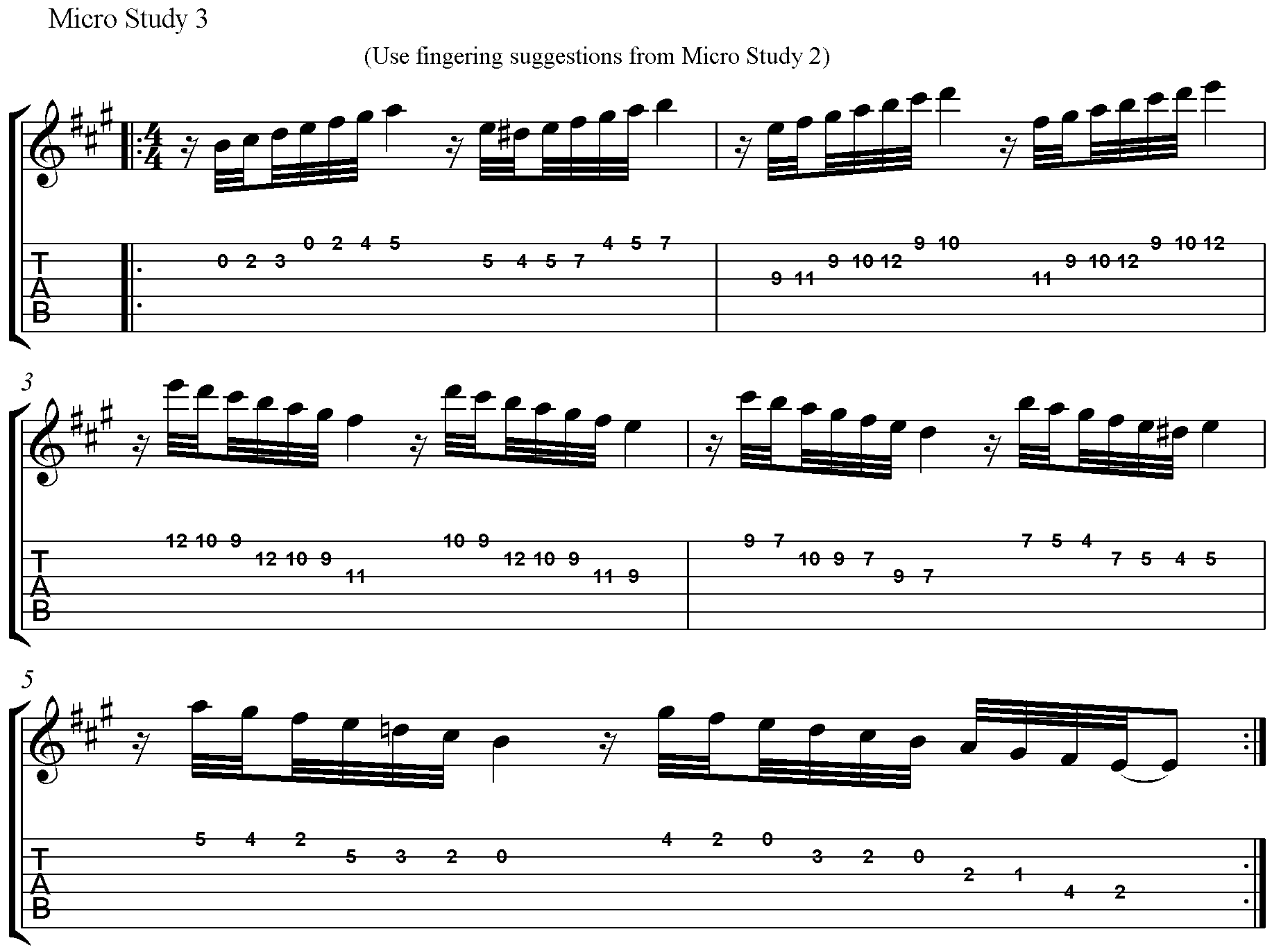
A word on the metronome. Start slow with the click on eighth notes, so you only think in groups of three or four per beat. Once you feel it, switch the click to quarter notes in your head. Watch out: the 32nd notes start with a very short rest. Find the right-hand fingers that land on the beat. At speed, those are your anchor points.
Left hand
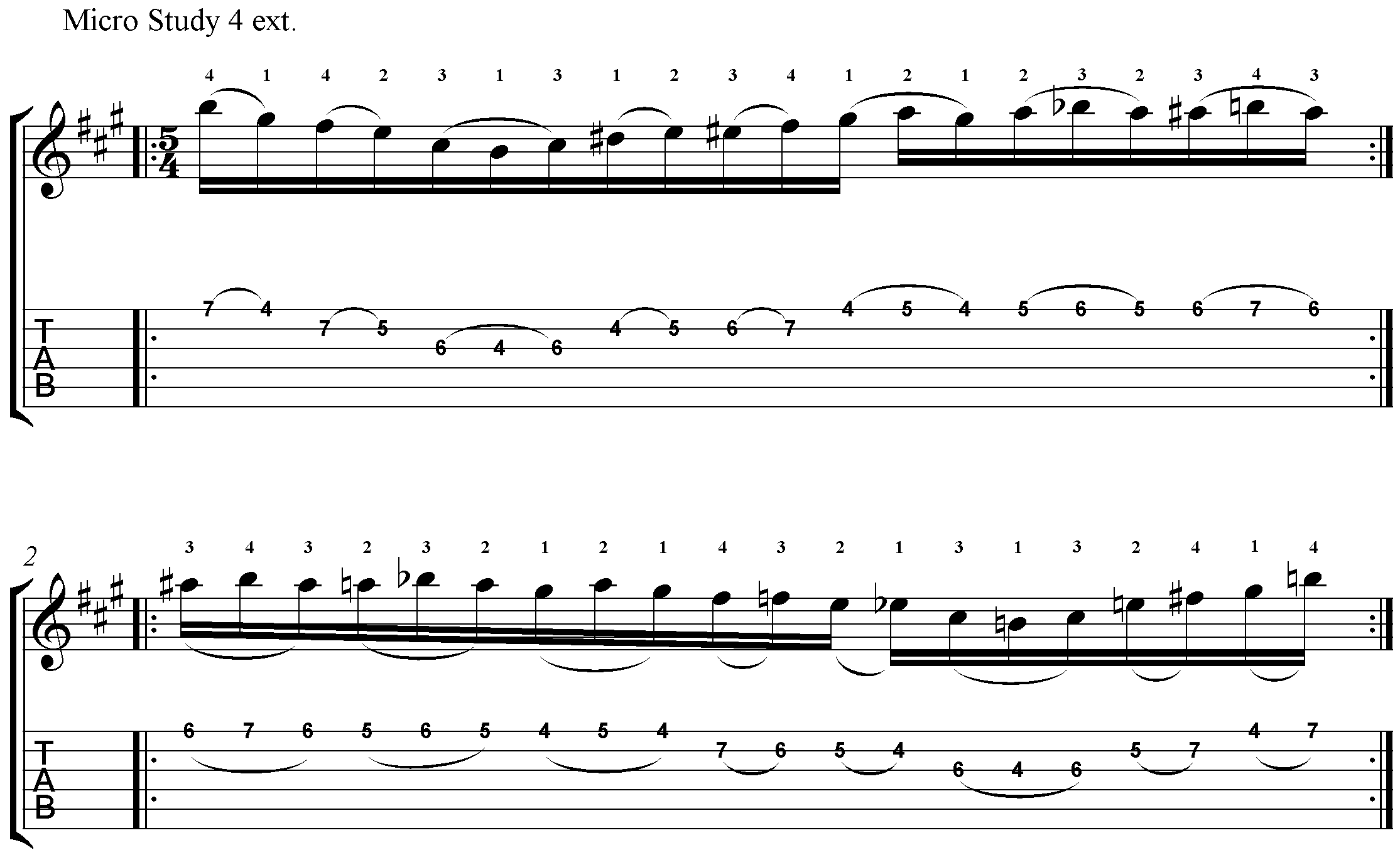
No. 16 is in binary form. Section A is scales into chord shapes, section B is chords into slurs. Micro Study 4 collects the most common left-hand slur combinations, and it will quickly show you any finger pair that is weaker than the rest. Work those further. Aim for an even tone between the slurred note and the right-hand stroke before it. Play it in reverse and you cover every left-hand finger combination.
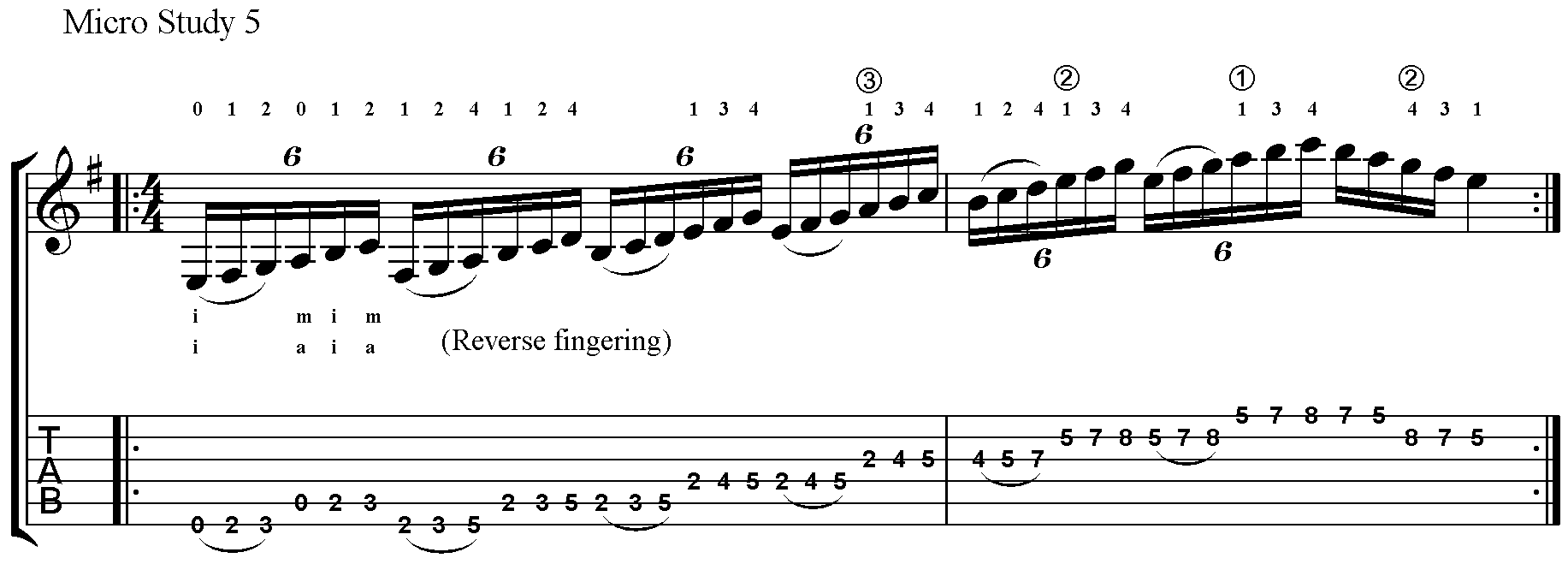
Micro Study 5 is a bonus: a Paul Gilbert-inspired rock idea, brought into a classical setting for coordination, speed and slurs. Again, split it into small bites if you need to.
Chords
Practise the chords on their own, away from the slurs and scales, until the shapes are familiar. Aguado wrote this for a short-scale guitar, and the shapes show it. You are here for coordination and speed, so don’t worry about proving your 19th-century chord contortionist skills. Work in three separate areas (chord shapes, scale fragments, then slurs) and the new techniques come quicker, and so does the speed later on.
Which edition?
The method went through four versions, from Madrid in 1820 to the final Nuevo Método (Madrid, 1843). Each one built on the last, so the 1843 edition is the one to trust. Tecla’s English translation of it is excellent.
I first wrote this lesson as a method article for Classical Guitar Magazine in Summer 2017. You can still read my original post about it.
Final reflection
Short as it is, No. 16 covers a lot of ground in fluid coordination, and Aguado’s method is still one of the pillars of modern technique. Brian Jeffery puts it best: “anyone who studies the book and successfully works his way through it will probably have received the most solid grounding in technique that any book can give him.” A young John Williams sight-read from it every day. And it is where the guitar’s detailed teaching on a clear tone comes from: the combined flesh-and-nail stroke guitarists still use today.